

Precise machining of refractory high entropy alloy by water-jet guided laser
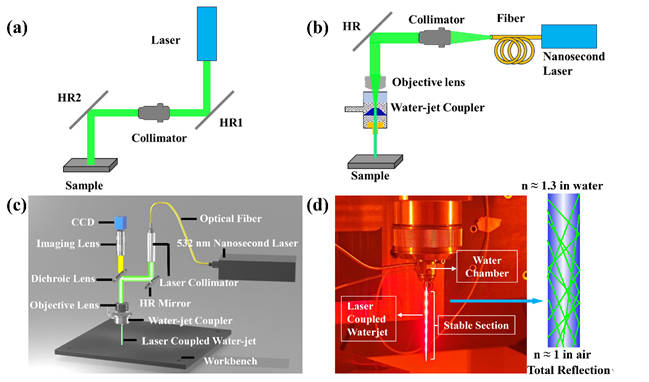
The experimental set-up of laser processing.
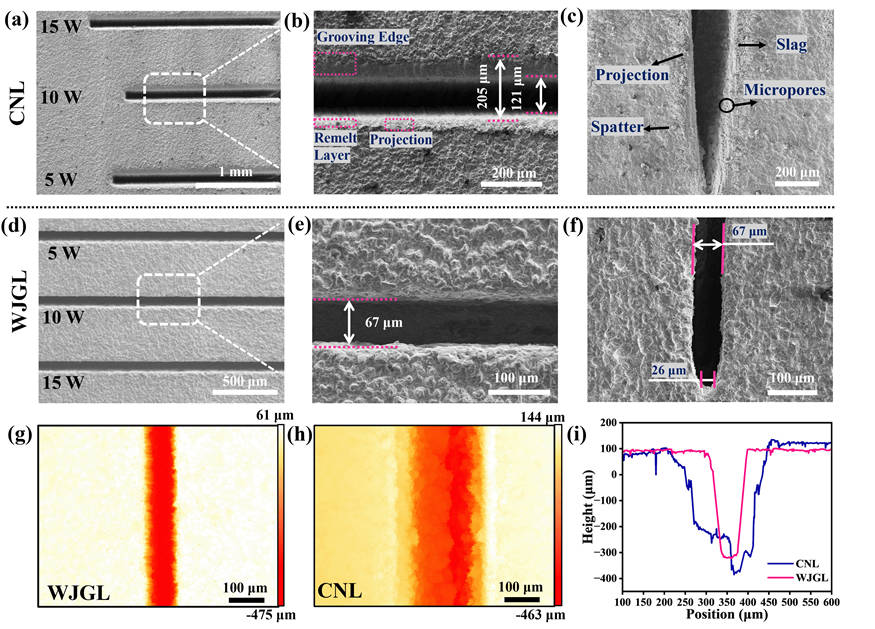
The processing comparison of CNL and WJGL.
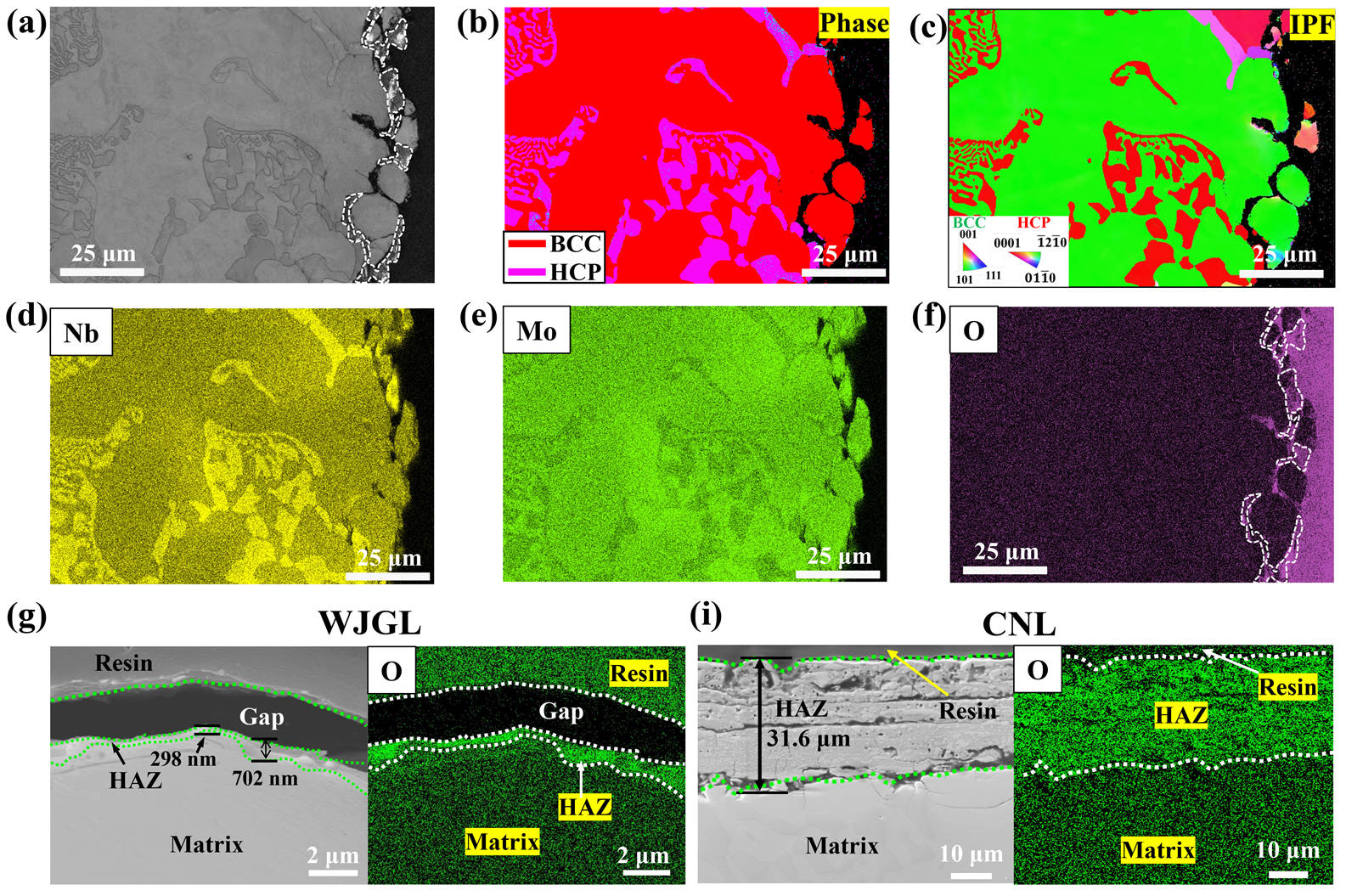
SEM images and mapping result of WJGL processed interface and material matric.
GA, UNITED STATES, September 5, 2026 /EINPresswire.com/ -- Precise micromachining of refractory high-entropy alloys keeps a significant challenge for inherent brittleness and low thermal conductivity. In this work, water-jet guided laser technology enables a higher micromachining quality compared with CNL and femtosecond laser. Notably, WJGL reduces the heat-affected zone (HAZ) to 298 nm, ~99.1% lower than that of CNL. The material removal mechanism and microstructural evolution are elucidated. This work provides a reliable route for precision manufacturing of hard-to-process RHEAs.
High-entropy alloys are highly promising structural and functional materials. Among them, refractory high-entropy alloys possess outstanding high-temperature mechanical properties and have broad application prospects in critical components under extreme working conditions such as aerospace, nuclear power, and gas turbines. However, the intrinsic characteristics of this type of material, such as high hardness, brittleness and poor thermal conductivity, are highly likely to cause microcracks and thermal damage during processing, posing a significant challenge to high-precision micromachining at room temperature. Laser machining is an effective technology for micro precision manufacturing, however, in view of the refractory high entropy alloys processing research focused on nanometer materials preparation and surface modification, and the traditional processing way also exacerbate the workpiece thermal damage, holes and surface defects. Therefore, how to overcome the thermal effect brought by the laser processing is the key to improving the processing and manufacturing of refractory high-entropy alloys.
What is the water jet guided laser processing technology?
This technology is utilizing water-jet and shielding gas as waveguide to couple laser. The waveguide structure formed by the refractive index difference between the high-pressure water jet and the protective gas is utilized, with the water jet as the core and the protective gas and air as the cladding. Total reflection occurs when the laser is coupled into a water jet with a diameter of only 50 μm. There is no need to consider the focus position and Rayleigh length during the processing. As a high-performance precision processing method, water jet-guided laser processing technology integrates multiple functions such as laser ablation, in-situ cooling and residue scouring. This technology can effectively suppress thermal damage, achieve a clean processing interface and ensure processing accuracy, with significant processing advantages.
Processing Advantage 1: Clean Processing Interface
The research team evaluated the processing effects of various lasers by comparing the microscopic morphology of the grooves. The edges of the grooves processed by traditional nanosecond and femtosecond lasers have obvious slag and sputtering residues, and there is a significant taper. The EDS results show that these redeposits are mainly oxides. However, the grooves processed by WJGL present a vertical profile and a smoother inner wall. This is mainly due to the scouring effect of the water jet, which significantly reduces the deposition of slag and sputtering residues.
Processing Advantage 2: Ultra-thin Heat-Affected Zone
The water jet not only reduces the accumulation of heat during processing, but also has the protective effect of blocking air, effectively reducing the oxidation reaction between the alloy and air under high temperatures. The notable feature of the heat-affected zone (HAZ) after processing is a higher oxygen content. It is worth noting that the width of the heat-affected zone after WJGL processing ranges from 298 to 702 nm, while the width of the heat-affected zone after CNL processing is 31.6 micrometers. Therefore, the WJGL technology effectively reduces the generation of oxides at the processing interface, significantly reduces the processing impact, and maximally maintains the inherent properties of the material.
Processing Advantage 3: Ultra-low taper drilling
In the WJGL technology, the laser has a longer energy transmission distance and a more uniform energy distribution in the water jet, which offers significant advantages in improving the quality of the drilling. By analyzing the surface profile of a drilling hole with a depth-to-diameter ratio of 3.53, the results show that the radius and surface roughness of the hole from the processing entrance to the processing exit are highly consistent, with the surface roughness variation being less than 1 micron. The calculated taper is the lowest at only 0.014°. Therefore, the WJGL technology has high quality characteristics in micro-drilling with low roughness and high consistency.
References
DOI
10.37188/lam.2026.099
Original Source URL
https://doi.org/10.37188/lam.2026.099
Funding information
This work was supported by National Key Research and Development Program of China (Grant number 2023YFE0200200), and National Natural Science Foundation of China (grant number U2141205,52171096).
Lucy Wang
BioDesign Research
email us here
Legal Disclaimer:
EIN Presswire provides this news content "as is" without warranty of any kind. We do not accept any responsibility or liability for the accuracy, content, images, videos, licenses, completeness, legality, or reliability of the information contained in this article. If you have any complaints or copyright issues related to this article, kindly contact the author above.
