

Connected Vehicle Market to Reach USD 266.14 Billion by 2035, Growing at 12.5% CAGR
Connected Vehicle Market
Asia-Pacific is climbing fastest at a 13.4% CAGR, powered by China's smart-road investment pipeline and South Korea's K-City test beds.
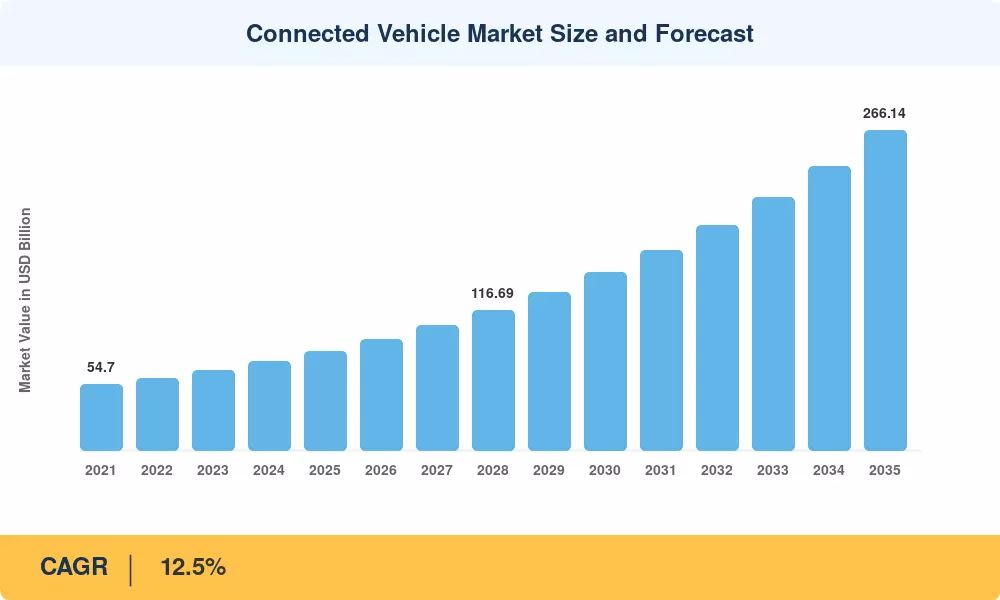
NEW YORK, NY, UNITED STATES, August 31, 2026 /EINPresswire.com/ -- According to Market Research Future, the Connected Vehicle Market is projected to reach USD 92.20 Billion in 2026 before climbing to USD 266.14 Billion by 2035, registering a CAGR of 12.5% during 2026–2035. This robust growth reflects the automotive industry's accelerating shift toward software-defined, always-connected vehicles, where cellular connectivity, cloud platforms, and vehicle-to-everything communication are becoming essential for safety, convenience, and business models. The Vehicle To Everything V2X Communication System Market continues to evolve alongside the broader connected vehicle ecosystem, while the In-Vehicle Connectivity Market underpins the hardware and software frameworks that enable seamless communication between vehicles, infrastructure, and cloud services.Market Overview
Connected vehicles leverage embedded telematics, wireless networks, and cloud-based platforms to exchange data with other vehicles, infrastructure, pedestrians, and backend systems. These technologies enable a wide spectrum of applications including safety and security services, telematics and diagnostics, driver assistance, over-the-air updates, infotainment, and fleet management. As the industry pivots toward software-defined vehicle architectures, connectivity has evolved from a premium feature to a foundational requirement across passenger and commercial vehicle segments.
The key growth drivers propelling this market expansion include regulatory mandates that establish a baseline for connectivity. European Commission Delegated Regulation 2024/1180, effective January 2025, compels all new light vehicles to migrate from circuit-switched eCall to packet-switched IMS networks, forcing the replacement of 2G and 3G modems with 4G or 5G chipsets . India's AIS-140 Amendment 3 extends real-time tracking and panic-button requirements to passenger cars by April 2026, deepening compliance demand . The growing deployment of 5G networks is enabling advanced connected vehicle applications with ultra-low latency requirements, particularly vital for autonomous driving and advanced driver assistance systems . Consumer demand for in-car infotainment, personalized services, and seamless smartphone integration continues to drive OEM investment in connectivity platforms, while fleet operators increasingly adopt telematics for routing optimization, predictive maintenance, and regulatory compliance .
Technological developments are reshaping the connectivity landscape at an accelerating pace. 4G/LTE maintained a 43.47% share of the connected vehicle market in 2025, benefiting from mature component pricing and global network coverage . However, 5G/C-V2X units are scaling rapidly with an 11.69% CAGR through 2031 as OEMs pursue latency improvements vital for autonomous driving and advanced driver assistance . Qualcomm's Snapdragon X85, announced in 2025, integrates sidelink and millimeter-wave radios on a 4-nanometer node, reducing power draw and cutting bill-of-materials by USD 35 relative to earlier discrete designs . Legacy 3G and 2G devices are being sunset, aligning with U.S. and EU shutdown schedules that make continued operation unsustainable .
Market Segmentation
The connected vehicle market is segmented based on technology type, application, connectivity, vehicle connectivity type, vehicle type, and end market to provide comprehensive insights into the industry landscape.
By Technology Type: The market is categorized into 5G/C-V2X, 4G/LTE, 3G, and 2G segments. 4G/LTE dominates current deployment, but dual-mode silicon supporting Release 14 sidelink and Release 17 positioning now adds only USD 15 per unit, down from USD 50 in 2023, helping global platforms standardize across regions . As economies of scale build, 5G modems are expected to overtake 4G share before 2028, reshaping supply chains and semiconductor roadmaps .
By Application: The market covers Safety and Security, Telematics and Diagnostics, Driver Assistance, and Over-the-Air Updates. Safety and security services held 38.13% of the market in 2025 as regulatory eCall mandates locked in baseline demand . Over-the-air updates post the quickest climb at an 11.77% CAGR, reflecting the move to software-defined vehicles capable of receiving multi-gigabyte firmware packages . Tesla's fleet alone uploaded more than 4 petabytes of sensor data in 2025, enabling cloud training and rapid feature releases .
By Connectivity: The market is segmented into Integrated, Embedded, and Tethered connectivity solutions.
By Vehicle Connectivity Type: The market covers Vehicle-to-Vehicle, Vehicle-to-Infrastructure, Vehicle-to-Pedestrian, Vehicle-to-Cloud, and Vehicle-to-Grid communication types.
By Vehicle Type: The market serves Passenger Cars and Commercial Vehicles segments. Premium passenger cars adopt 5G twice as often as light commercial vehicles, but freight operators still favor robust 4G chipsets paired with electronic logging devices .
By End Market: The market is divided into OEM-Fitted and Aftermarket channels.
By Region: The market analysis covers North America, Europe, South America, Asia Pacific, and the Middle East and Africa.
🛒 You can buy this market report at:
https://www.marketresearchfuture.com/checkout?currency=one_user-USD&report_id=21315
Regional Analysis
Europe dominated with 34.57% of the connected vehicle market share in 2025, driven by eCall packet-switched migration deadlines and the deployment of numerous C-Roads roadside units that stream hazard alerts across Germany, Austria, and the Netherlands . Germany boasts the highest density of active units along its Autobahn corridors. However, the United Kingdom faces delays due to post-Brexit regulatory differences, while Southern European nations adopt at a slower pace, hindered by consumer resistance to subscription fees . Germany, France, and the United Kingdom lead regional adoption, supported by stringent EU General Safety Regulation provisions on cybersecurity and event data recorders taking effect starting in 2026 .
Asia Pacific posts the fastest growth at an 11.75% CAGR through 2031 as China mandates LTE-V2X on new-energy vehicles and channels significant investment into V2X infrastructure across Wuxi, Changsha, and Chongqing . Wuxi's 1,200 roadside units cut intersection accidents in 2025, proving safety dividends . Japan and South Korea fund urban V2X pilots that retrofit hundreds of intersections, while India's AIS-140 Amendment 3 extends real-time tracking to passenger cars by 2026 . China, with a significant number of active 5G base stations, leads global deployment, with many stations facilitating C-V2X roadside functions . South Korea allocated substantial funding in 2025 to upgrade numerous intersections with low-latency V2X technology .
North America represents a significant growth market, with the Federal Highway Administration underscoring its commitment to digitizing freight corridors by adding several roadside units along a major interstate in 2025 . The United States benefits from strong investment in connected vehicle platforms, V2X trials, and smart infrastructure funding. The region's robust regulatory framework regarding vehicle safety is accelerating adoption of connected vehicle technologies. Canada follows similar trends with investments in smart infrastructure and cooperative freight systems.
South America and the Middle East and Africa represent emerging markets with developing potential. Brazil pushes forward with congestion management and freight connectivity demands. In the Middle East, the UAE and Saudi Arabia are positioning as regional hubs for smart and connected mobility through economic diversification and smart city development. Africa remains in early stages, with South Africa leading adoption supported by improving infrastructure and economic conditions.
Competitive Landscape and Key Players
The connected vehicle market is highly competitive, featuring a mix of established automotive suppliers, technology giants, semiconductor manufacturers, and connectivity providers. The competitive landscape is characterized by vertical integration, strategic partnerships, and ecosystem development.
Key players operating in this market include Robert Bosch GmbH, Continental AG, Harman International (Samsung), Denso Corporation, Qualcomm Technologies Inc., NXP Semiconductors, Visteon Corporation, and TomTom International . Leading companies are distinguishing themselves through vertically integrated platforms, open partner ecosystems, and investments in secure, software-defined architectures . Certain OEMs are consolidating control over user experience by integrating infotainment and telematics stacks, while tier suppliers differentiate through sensor fusion capabilities and robust telematics control units .
Strategic developments are reshaping the competitive landscape. In March 2024, NXP Semiconductors announced its acquisition of a V2X technology firm to enhance its capabilities in the connected vehicle space . In January 2024, Qualcomm Technologies announced the launch of its latest V2X communication platform, designed to enhance vehicle connectivity and safety through advanced algorithms facilitating real-time data exchange between vehicles and infrastructure . Connectivity providers and cloud vendors are expanding managed services to support fleet analytics and real-time diagnostics, enabling faster time-to-value for fleet operators and mobility services .
Innovation and technology initiatives are accelerating across the industry. Software firms specializing in analytics, over-the-air updates, and cybersecurity are forging deeper commercial ties with OEMs to deliver end-to-end solutions . These strategic alignments reflect an industry move toward platform-based offerings that combine hardware, software, and services under recurring revenue models . New entrants are leveraging modular hardware and lightweight software stacks to address niche opportunities in V2X, satellite-augmented connectivity, and aftermarket telematics .
Latest Industry News and Developments
Recent industry developments highlight the dynamic nature of the connected vehicle market. Regulatory mandates continue to shape deployment. European Commission Delegated Regulation 2024/1180, effective January 2025, compels all new light vehicles to migrate to packet-switched eCall networks . Russia's ERA-GLONASS upgrade added LTE positioning in 2024, further solidifying the regulatory floor . UNECE WP.29 Regulation 155 mandates a certified cyber-security management system before type approval, requiring smaller OEMs to partner with tier-1 suppliers holding ISO/SAE 21434 certification .
Technology demonstration projects continue to advance connected vehicle capabilities. In 2025, the Federal Highway Administration added several roadside units along a major U.S. interstate to digitize freight corridors . South Korea allocated substantial funding in 2025 to upgrade numerous intersections with low-latency V2X technology for enhanced pedestrian safety . China, with a significant number of active 5G base stations, continues to lead global C-V2X deployment, with many stations facilitating roadside functions .
Market Challenges and Opportunities
The connected vehicle market faces several key challenges that could impact growth trajectories. Cybersecurity vulnerabilities in connected vehicle gateways have been reported by the European Union Agency for Cybersecurity, including remote unlock and immobilizer attacks affecting multiple vehicle models . While ISO/SAE 21434 provides a framework for processes, a TUV SUD audit revealed that a significant portion of tier-2 suppliers were not fully compliant, highlighting potential vulnerabilities . Data privacy regulations such as the General Data Protection Regulation (GDPR) impose substantial fines, acting as a deterrent against aggressive data monetization, while the California Consumer Privacy Act empowers drivers to request deletion of their trip records, adding complexity to usage-based insurance models . High cellular data costs and OEM-mobile network operator revenue conflicts present additional challenges .
Emerging opportunities are abundant in the evolving mobility landscape. The shift toward software-defined vehicles enables OEMs to treat vehicle connectivity as a platform for recurring revenue, with major automakers generating significant software-related revenue through subscription services, feature-on-demand offerings, and data monetization . Vehicle app stores, subscription models, and telemetry-based services create new revenue streams. The growing demand for autonomous driving and advanced driver assistance systems drives need for low-latency V2X communication and robust connectivity platforms. The integration of connected vehicle data with smart city infrastructure, traffic management systems, and mobility platforms creates comprehensive mobility solutions.
Future growth potential remains exceptionally strong, driven by the ongoing transition toward software-defined, connected, and autonomous vehicles. Organizations that align modular technical architectures with diversified sourcing, robust cybersecurity practices, and service-oriented commercial models will be best positioned to capitalize on the evolving connected vehicle ecosystem . Strategic partnerships across software, cloud, telecom, mapping, and cybersecurity ecosystems can accelerate deployment while maintaining interoperability and data ownership protections .
To explore more market insights, visit us at:
https://www.marketresearchfuture.com/reports/connected-vehicle-market-21315
Final Market Summary
The connected vehicle market is poised for substantial growth, driven by regulatory mandates, technological innovation, and the accelerating transition to software-defined vehicle architectures. The market's trajectory from USD 92.20 Billion in 2026 to USD 266.14 Billion by 2035 reflects the critical importance of connectivity in enabling modern vehicle functions, safety, and business models.
The long-term industry potential remains strong, with advancements in 5G/C-V2X technology, edge computing, and AI-powered analytics continuing to expand the addressable market. The convergence of connected vehicles with broader mobility ecosystems, including autonomous driving, electric vehicle platforms, and smart city infrastructure, is creating comprehensive solutions that serve diverse customer needs.
Key factors expected to influence future development include the pace of 5G network deployment, the evolution of regulatory frameworks, and the transition to software-defined vehicle architectures. Investments in secure, interoperable connectivity platforms and robust cybersecurity frameworks will enable manufacturers to meet evolving regulatory requirements and consumer expectations. As vehicles become increasingly connected, autonomous, and software-defined, the role of connectivity will continue to expand, ensuring sustained innovation and growth throughout the forecast period and beyond.
More Related Reports from MRFR Library:
Dairy Processing Equipment Maintenance Services Market : https://www.marketresearchfuture.com/reports/dairy-processing-equipment-maintenance-services-market-66441
Dairy Production MRO Services Market : https://www.marketresearchfuture.com/reports/dairy-production-mro-services-market-66443
Fleet Maintenance Services Market : https://www.marketresearchfuture.com/reports/fleet-maintenance-services-market-66781
Food and Beverage MRO Services Market : https://www.marketresearchfuture.com/reports/food-and-beverage-mro-services-market-66790
Greenhouse system MRO Services Market : https://www.marketresearchfuture.com/reports/greenhouse-system-mro-services-market-66867
Industrial Crane Maintenance and Repair Services Market : https://www.marketresearchfuture.com/reports/industrial-crane-maintenance-and-repair-services-market-67016
Industrial Valve Repair and Maintenance Services Market : https://www.marketresearchfuture.com/reports/industrial-valve-repair-and-maintenance-services-market-67044
Marine Boilers Maintenance and Repair Services Market : https://www.marketresearchfuture.com/reports/marine-boilers-maintenance-and-repair-services-market-67243
Medical Laboratory Equipment MRO Services Market : https://www.marketresearchfuture.com/reports/medical-laboratory-equipment-mro-services-market-67318
Mining Conveyor System Repair and Maintenance Market : https://www.marketresearchfuture.com/reports/mining-conveyor-system-repair-and-maintenance-market-67350
Market Research Future
Market Research Future
+1 855-661-4441
email us here
Legal Disclaimer:
EIN Presswire provides this news content "as is" without warranty of any kind. We do not accept any responsibility or liability for the accuracy, content, images, videos, licenses, completeness, legality, or reliability of the information contained in this article. If you have any complaints or copyright issues related to this article, kindly contact the author above.
