

Micronized Silicon Market Forecast 2026–2036: Market to Reach USD 1,113.6 Million by 2036 at 6.7% CAGR | FMI Report
Rising demand for high-performance materials in batteries, electronics, and advanced manufacturing drives steady global expansion
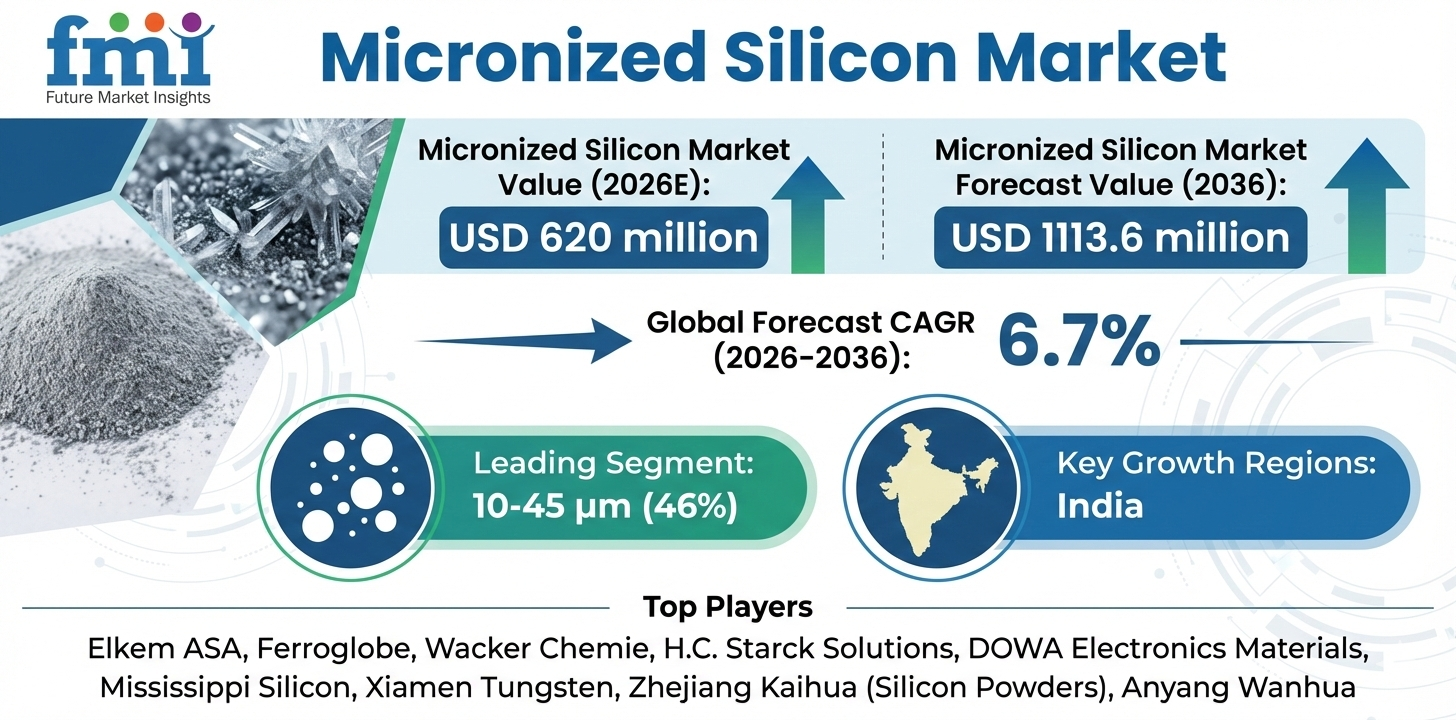
NEWARK, DE, UNITED STATES, February 26, 2026 /EINPresswire.com/ -- The global micronized silicon market is valued at USD 620 million in 2026 and is projected to reach USD 1,113.6 million by 2036, expanding at a CAGR of 6.7% from 2026 to 2036. Growth is supported by increasing adoption of fine silicon powders in lithium-ion batteries, semiconductors, specialty coatings, and advanced construction materials.
As industries demand higher efficiency, improved conductivity, and enhanced surface reactivity, micronized silicon is transitioning from a specialty additive to a strategic performance material embedded across energy storage, electronics, and advanced manufacturing supply chains.
Micronized Silicon Market Snapshot (2026–2036)
• Market size in 2026: USD 620 million
• Market size in 2036: USD 1,113.6 million
• CAGR (2026–2036): ~6.7%
• Leading purity grade: Metallurgical grade (44% share)
• Leading particle size: 10–45 µm (46% share)
• Fastest-growing country: India (8.9% CAGR)
• Key end-use drivers: Energy storage, electronics, aluminum alloys
• Major players: Elkem ASA, Ferroglobe, Wacker Chemie, H.C. Starck Solutions, DOWA Electronics Materials
Market Momentum
The micronized silicon market begins at USD 620 million in 2026, supported by rising utilization in specialty elastomers, adhesives, coatings, and battery anode formulations. Between 2027 and 2030, consistent year-on-year expansion reflects growing integration into lithium-ion battery manufacturing and semiconductor materials.
By the early 2030s, technological advancements in jet milling and precision micronization improve particle size control and purity standards, enabling wider adoption in high-performance applications. By 2036, the market surpasses USD 1.1 billion as electric vehicle production, renewable energy storage deployment, and electronics miniaturization accelerate global demand.
Request For Sample Report | Customize Report |purchase Full Report - https://www.futuremarketinsights.com/reports/sample/rep-gb-30888
Why the Market is Growing
The micronized silicon market is expanding due to increasing demand for materials that deliver enhanced conductivity, improved mechanical reinforcement, and higher energy density. In lithium-ion batteries, micronized silicon functions as an anode additive, increasing charge capacity and improving energy storage performance—critical for electric vehicles and grid-scale storage systems.
In electronics and semiconductors, fine silicon powders support improved thermal management and electrical properties. Meanwhile, in aluminum-silicon alloys, metallurgical-grade micronized silicon enhances strength-to-weight ratios, supporting lightweight automotive manufacturing.
Beyond performance, industrial buyers value micronized silicon for its ability to improve formulation consistency and reduce viscosity in polymer matrices. As energy efficiency and high-performance engineering become central to manufacturing strategies, micronized silicon demand continues to strengthen.
Segment Spotlight
1. Purity Grade: Metallurgical Grade Leads
Metallurgical-grade silicon accounts for approximately 44% of market share. Its widespread use in aluminum alloys, automotive castings, and construction materials supports cost-effective performance optimization in large-volume applications.
2. Particle Size: 10–45 µm Dominates
The 10–45 µm particle size segment represents around 46% of total demand. This range provides an optimal balance between surface area, dispersion behavior, and processability, making it suitable for semiconductors, batteries, and conductive polymers.
3. End Use: Energy Storage Accelerates Growth
While aluminum and metallurgy remain strong contributors, energy storage applications are expanding rapidly. The integration of micronized silicon into lithium-ion battery anodes enhances energy density, supporting electric vehicle adoption and renewable energy expansion.
Drivers, Opportunities, Trends, and Challenges
Drivers:
• Expansion of electric vehicle production
• Growth in renewable energy storage systems
• Increasing semiconductor miniaturization
Opportunities:
• Advanced battery-grade silicon formulations
• Expansion into specialty ceramics and conductive polymers
• Process innovation in micronization technologies
Trends:
• Higher purity and tighter particle size distribution standards
• Vertical integration by major producers
• Long-term supply contracts with battery manufacturers
Challenges:
• High capital investment in micronization infrastructure
• Strict regulatory compliance in electronics markets
• Competition from alternative advanced materials
Country Growth Outlook (2026–2036)
India leads global growth at 8.9% CAGR, driven by rapid expansion in electronics manufacturing, electric vehicle production, and renewable energy initiatives. China follows closely at 8.4%, supported by its dominant battery manufacturing ecosystem and strong industrial base.
Indonesia (7.3%) and Brazil (6.3%) benefit from expanding automotive and infrastructure sectors. The United States grows at 4.1%, supported by steady demand from semiconductor innovation and energy storage deployment.
Competitive Landscape
The micronized silicon market is moderately consolidated, with dominant players maintaining pricing power through advanced production techniques, long-term contracts, and exclusive supply agreements. High capital requirements and specialized micronization expertise create significant entry barriers, limiting large-scale participation by smaller firms.
Market leaders focus on technological refinement, purity enhancement, and scalable production capabilities. Strategic investments in precision milling, quality assurance systems, and customer-specific material development allow established companies to defend market share.
Although fragmentation persists due to diverse application requirements, consolidation is expected to increase as larger firms pursue acquisitions and technological upgrades to strengthen global supply positions.
Frequently Asked Questions (FAQ)
What is the global micronized silicon market size?
The market is valued at USD 620 million in 2026 and is projected to reach USD 1,113.6 million by 2036.
At what rate is the market expected to grow?
The market is forecast to expand at a CAGR of approximately 6.7% from 2026 to 2036.
What drives demand for micronized silicon?
Key drivers include growth in lithium-ion batteries, semiconductor miniaturization, aluminum alloy production, and renewable energy systems.
Which segment holds the largest share?
Metallurgical-grade purity leads with 44% share, while the 10–45 µm particle size segment accounts for 46% of market demand.
Explore More Related Studies Published by FMI Research:
Aluminum Hydroxide Market https://www.futuremarketinsights.com/reports/aluminum-hydroxide-market
Cathodic Acrylic Market https://www.futuremarketinsights.com/reports/cathodic-acrylic-market
Nano Composite Zirconia Market https://www.futuremarketinsights.com/reports/nano-composite-zirconia-market
About Future Market Insights (FMI)
Future Market Insights (FMI) is a leading provider of market intelligence and consulting services, serving clients in over 150 countries. Headquartered in Delaware, USA, with a global delivery center in India and offices in the UK and UAE, FMI delivers actionable insights to businesses across industries including automotive, technology, consumer products, manufacturing, energy, and chemicals.
Why Choose FMI: https://www.futuremarketinsights.com/why-fmi
Sudip Saha
Future Market Insights Inc.
+ +1 347-918-3531
rahul.singh@futuremarketinsights.com
Legal Disclaimer:
EIN Presswire provides this news content "as is" without warranty of any kind. We do not accept any responsibility or liability for the accuracy, content, images, videos, licenses, completeness, legality, or reliability of the information contained in this article. If you have any complaints or copyright issues related to this article, kindly contact the author above.
